23 December, 2009

What's the difference between barre chords, power chords and open barre chords

I was recently asked this question. It was actually just the difference between barre chords and power chords. I added in "open barre chords" because to me, it's also important to know what they are.

First of all, I did a google search but couldn't find the term "open barre chords", so I guess I just invented another term. Not to worry, I'll explain later in this post what I mean when I say "open barre chord".

Okay, I think by now, you should know what a barre chord is, and how to play a barre chord. If not, you can read about it here and here. So now, let me explain what a power chord is then. A power chord is almost like a barre chord. The only difference is that you don't strum all 6 strings (if you're playing on the 6th string), or 5 strings (if you're playing on the 5th string). Instead, you strum only the 6th, 5th and 4th string (if you're playing on the 6th string) or 5th, 4th and 3rd string (if you're playing on the 5th string.)

I will use two chords as an example. Let's use the example of a power chord A (on the 6th string), and a power chord D (on the 5th string):


("X" means you do not strum those strings)

So, if you play the above, you will get an A and a D power chord respectively. An interesting thing to note about the power chord is that it can be used regardless whether the note is a major or a minor. So, that means if you're playing a song in the key of G (you have an Am in the family of G), you just need to play the above power chord A. You don't have to play an Am (there is no power chord Am anyway).

Generally, power chords are used by electric guitar players. They also add effects to it such as distortion, and it sound pretty nice, especially for rock or heavier song.I would not suggest you to use them in acoustic songs - unless you want the song to sound heavy.

Next, I'll talk about what an open barre chord is. I will also show you two examples. One of them on the 6th string, and the other on the 5th string:


Okay, notice the difference between the open barre chord and a standard barre chord? Your index finger doesn't have to barre the whole fret. You let the other strings ring. I kind of use these chords quite often in my videos as well because I find it has a really nice sound as compared to a standard barre chord.

One thing to note about this open barre chord is that it does not sound nice on all chords. The chords where it sounds nice are:

6th string - F# (2nd fret), A (5th fret),
5th string - B (2nd fret), C# (4th fret), E (7th fret)

Of course you could try the other frets, but some of them just sound terrible.

I hope this post has made it more clear the difference between a barre chord, power chord and open barre chord.

16 December, 2009

HOW TO play special / split / slash chords

In this post, I will be writing about how to play special / split  / slash chords on the guitar. First of all, I need to qualify what I mean when I use the term "special". For a lack of a better word, the chords that I am actually referring to are those where you see a "/". For example, I'm sure you would have come across chords such as D/F#, D/B, C/E, A/C# etc. (thanks to Bob for letting me know that these are called split chords)

Alright, let's get things started. I used to think that the "/" meant that you could either play the chord before the "/" or the chord after the "/". But I was wrong. It's okay if you thought that as well because I thought that too. Anyway, simply put, the chord after the "/" just means that you have to play that bass note. So, if you see a D/F#, it means you play a D root note, and a F# bass note.

How does this translate to playing the chord? Well, here's how it looks graphically:


For myself, I personally like to use the D2/F# or Dsus/F# chord. But if you have watched my videos over youtube, I just generally call them D/F# because I don't want to get too technical with the names.

Ok, here are some other "special" chords that I have used before (I'll just use the general names as well because I don't want to get too specific on what their correct names should be):


There are many more "special" chords out there. So don't get scared of you happen to see an unfamiliar one while reading a music sheet or learning a song using some online tabs. All you have to do is take a deep breath, look at the chord before the "/", play that chord, then look at the chord after the "/", and play that bass note.

With that being said, this is also why you need to know your fretboard well. Where is the B bass note on your guitar? Where is the C# bass note on your guitar? If you know your fretboard well enough, playing these special chords will be a walk in the park.

I hope this post has been useful and informative. Continue to practice hard, and remember, I am even learning new things about the guitar everyday.

09 December, 2009

HOW TO pluck the guitar with your fingers

In this post, I will attempt to answer the question on how to pluck the guitar the proper way.

First of all, I can't really say whether the way I pluck is the proper way to do so because I have never taken any guitar lessons. So, all of this is what I feel is correct.

Ok, during my lessons with my guitar students, I have noticed that many of those who are total beginners have the tendency to pluck in a certain way. They pluck each string using just one finger - the thumb. So I'll just say it now, you should use the rest of your fingers as well to pluck the guitar!


The pictures above shows you two ways which you can position your fingers when plucking. For myself, I prefer to use the one on the right (where the pinky is on the guitar) because I find it helps to keep my plucking hand in place. The only drawback is that after a prolong period of placing your pinky in this manner, it gets stiff and can hurt a little.

Anyway, notice how each finger is placed on a string? In my case, I make use of 3 fingers and the thumb. So the next question you might probably ask is "There are 6 strings on a guitar, if I'm only using 4 fingers, what finger do I use for the remaining 2 strings?"

The answer is simple. For me, I use my thumb to pluck the 4th, 5th and 6th string (I call these strings the bass strings). So, when I play a D chord for example, I'll use my thumb for the 4th string. If I play an A chord, I'll use my thumb for the 5th string. If i use an E chord, I'll use my thumb for the 6th string. The rest of my 3 fingers are placed on the 1st - 3rd string.

Yup, that's basically it. In another post, I'll probably be talking about simple plucking patterns that you can use for songs.

02 December, 2009

HOW TO hold a pick/plectrum when strumming

In this post, I will be talking about how to hold a pick or how to hold a plectrum when strumming. They are both the same, just different names.

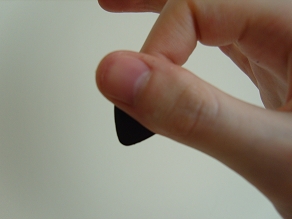
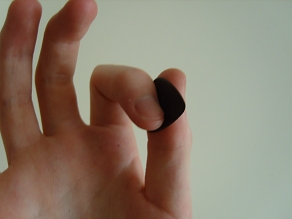
First of all, we need to know how to hold a pick correctly. Here's a picture to show you how it should look like:

Top View                                                    Bottom View
         

Next, we will proceed to how you should hold the pick when strumming. Don't get me wrong here, you should hold the pick the way you see it in the pictures above. What I meant was that there are certain things to take note of when strumming with the pick. The reason why I say this is because people have sometimes been asking me how come their guitar strumming seems to sound so loud and forceful. So, here's what you have to take note when strumming:

For strumming, the pick should be held at a 45 degree angle tilted upwards when doing a downstroke. This will ensure that there is not too much force used when strumming. Most of the time, I see beginners holding the pick 90 degrees or perpendicular to the strings when strumming. This will cause the strumming to be very forceful and loud. More importantly, this is the wrong way to hold a pick when strumming.

The same thing goes for the upstoke when strumming. If you do the upstroke holding the pick 90 degrees or perpendicular to the strings, you will get a loud and forceful strum. So, you should hold the pick 45 degrees downwards, and just use your wrist to flick upwards on the upstroke.

I can imagine that all this can be quite hard to visualise. So, here's some pictures to visually explain more clearly what I am referring to.

Strumming (Downstroke)


Strumming (Upstroke)


I hope this post has been useful and helpful. Feel free to ask any questions if you have any doubts.